Walther P38: Difference between revisions
Skizmophonic (talk | contribs) Update weapon stats from scripts; hide Fire Rate on semi-auto-only weapons |
Skizmophonic (talk | contribs) Update weapon stats from scripts; remove Fire Rate on semi-auto-only weapons |
||
| Line 32: | Line 32: | ||
! rowspan=2 | [[Weapon Type]] | ! rowspan=2 | [[Weapon Type]] | ||
! rowspan=2 | [[Fire Modes]] | ! rowspan=2 | [[Fire Modes]] | ||
! rolspan=2 | [[Bullet Spread °]] | ! rolspan=2 | [[Bullet Spread °]] | ||
! rolspan=2 | [[Range Modifier]] | ! rolspan=2 | [[Range Modifier]] | ||
| Line 39: | Line 38: | ||
! rolspan=2 | [[Weight]] | ! rolspan=2 | [[Weight]] | ||
|- | |- | ||
|[[Walther P38]]||[[Pistol]]||Semi | |[[Walther P38]]||[[Pistol]]||Semi||6.31 / 2.29 [[ADS]]||0.75||315 m/s||6.1 g (94.14 gr)||0.8 kg (1.76 lbs) | ||
|- | |- | ||
|} | |} | ||
Latest revision as of 01:00, 15 June 2026
| Factions | Weapon | Icon | Classes | Ammo |
|---|---|---|---|---|
 VC |
 Walther P38 |
 |
Everyone Except Sniper |
8+1 / 24 |
| Damage Base | Headshot × | Chest × | Stomach × | Leg × | Arm × | Reload Speed | |
|---|---|---|---|---|---|---|---|
| Partial | Empty | ||||||
| 29 | ×2.4 = 69.6 | ×1.6 = 74.2 | ×1.5 = 43.5 | ×1.15 = 33.3 | ×1.15 = 33.3 | 2.3 Seconds | 2.9 Seconds |
| Designation | Weapon Type | Fire Modes | Bullet Spread ° | Range Modifier | Muzzle Velocity | Projectile weight | Weight |
|---|---|---|---|---|---|---|---|
| Walther P38 | Pistol | Semi | 6.31 / 2.29 ADS | 0.75 | 315 m/s | 6.1 g (94.14 gr) | 0.8 kg (1.76 lbs) |
| Full name | Caliber | Place of Origin | Date | Manufacturer | Barrel Length | Total Length | Weapon Script Name |
|---|---|---|---|---|---|---|---|
| Walther P38 | 9x18mm | Nazi Germany | 1939 | Carl Walther Waffenfabrik, Mauser Werke, Spreewerk |
4.9 in (125 mm) | 8.5 in (216 mm) | weapon_p38 |
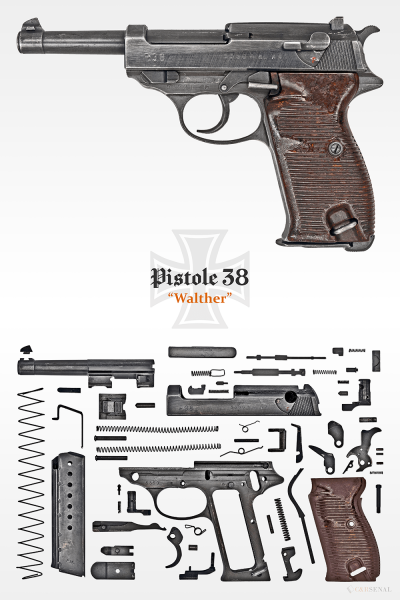
The Walther P38 is a German semi-automatic pistol chambered in 9×19mm Parabellum. It introduced a double-action/single-action (DA/SA) trigger with a decocking safety lever on a locked-breech service pistol, features that influenced many later handguns. The P38 is best known as the Wehrmacht’s standard replacement for the Luger P08 during World War II.
HISTORY
Germany began seeking a replacement for the expensive, labor-intensive Luger in the late 1920s, eventually selecting Walther’s P38 after a series of trial and “test” pistols in the late 1930s. Adopted in 1938 and entering mass production in 1940, the P38 used a short-recoil system with a locking block, allowing faster production than the P08 while providing modern features such as a decocking safety and a loaded-chamber indicator.
After World War II, large numbers of P38 pistols were captured, rebuilt, and redistributed, and the design continued in postwar forms (including French manufacture at Manurhin and later German P1 variants). Because of this wide postwar circulation, P38 pistols and related variants occasionally appeared far beyond Europe as surplus or captured sidearms, especially where older stocks remained in service for secondary roles.
Sources
- Imperial War Museums – The Walther P-38 pistol (collection entry)
- Royal Armouries – Centrefire self-loading military pistol: Walther Model P.38 (collection entry)
- Royal Museums Greenwich – Walther P38 pistol (collection entry)
- Osprey Publishing – Walther Pistols: PP, PPK and P 38
-
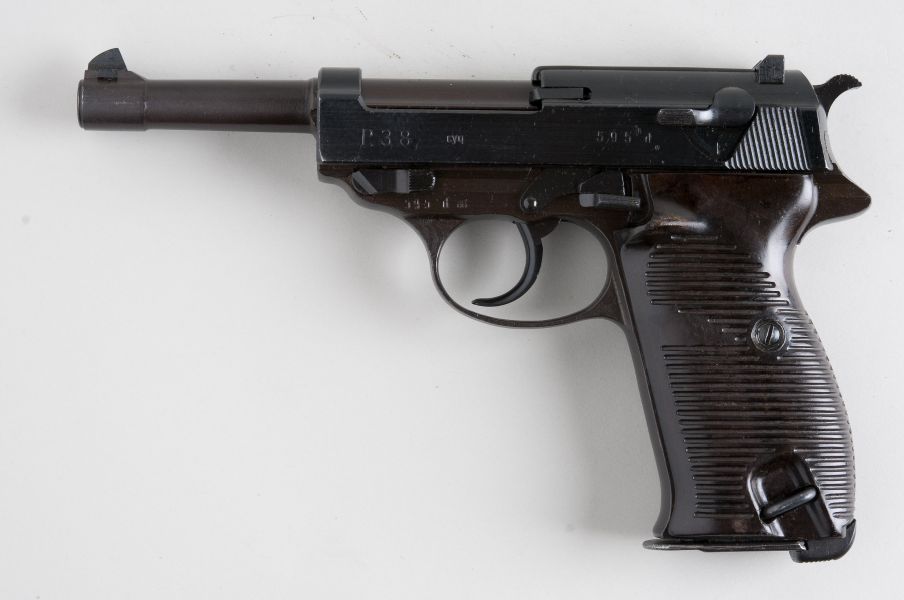 Walther P38 pistol.
 -
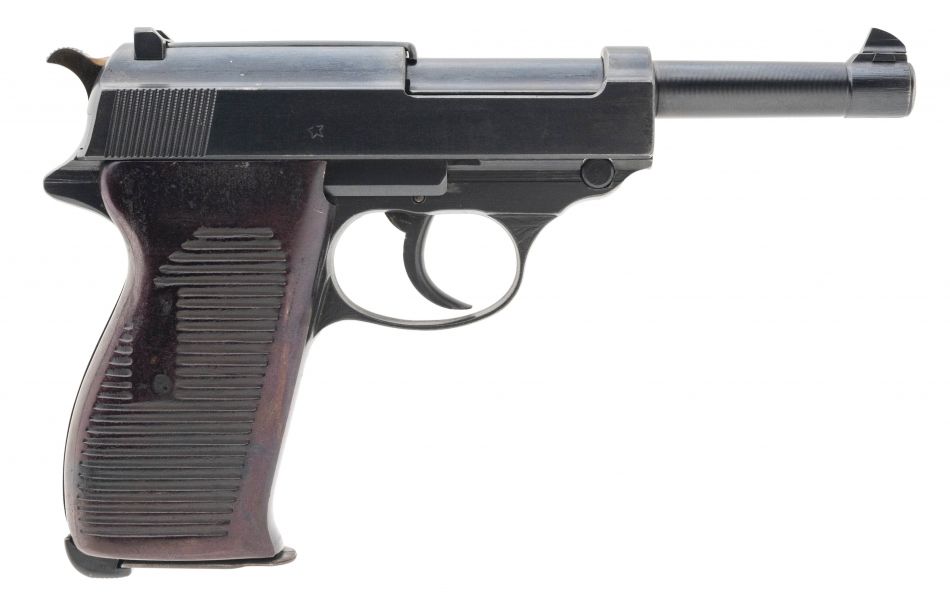 Postwar “Gray Ghost”-style P38/P1 variant.
 -
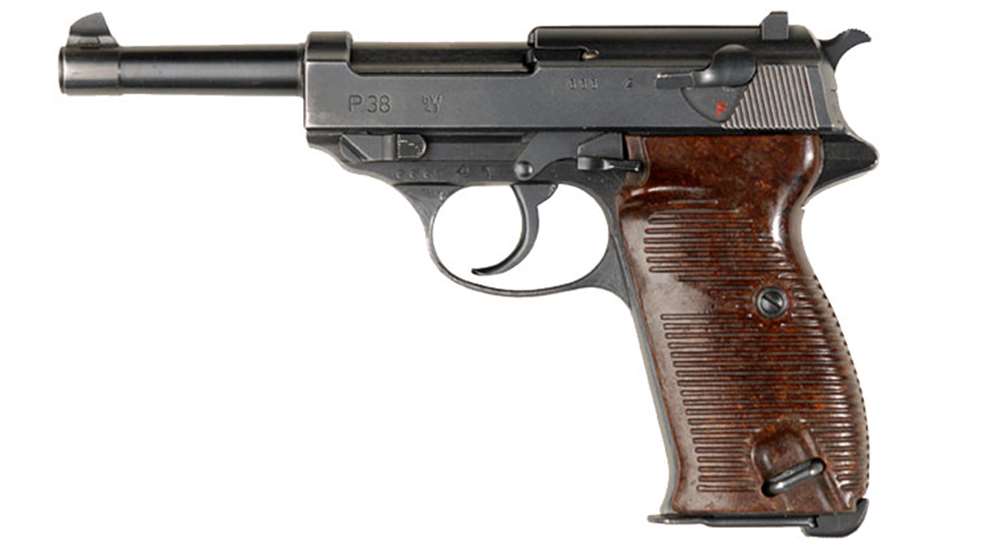 Walther P38, profile view.
 -
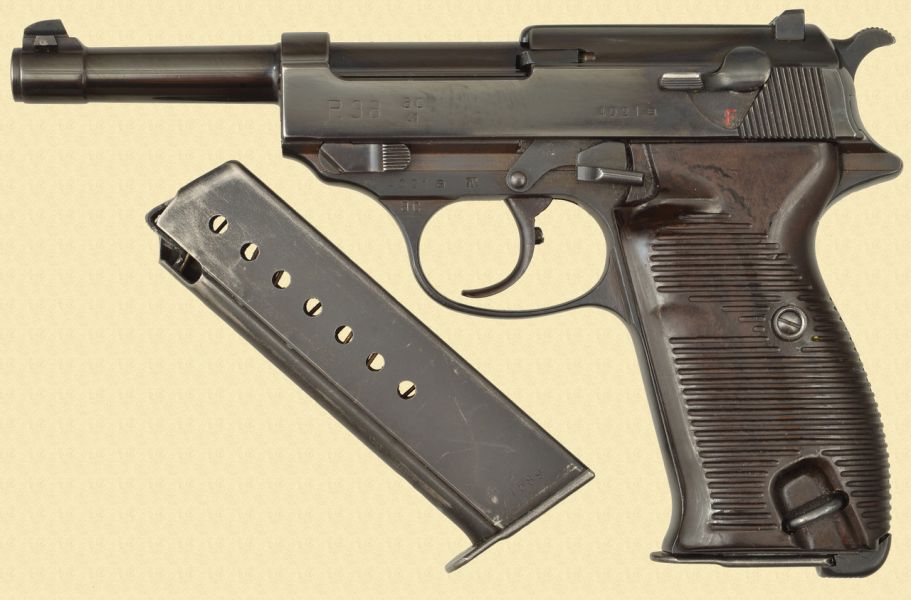 Walther P38, detail view.
 -
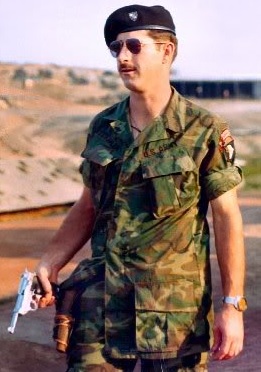 Vietnam: L Co Ranger with a chrome P38.
 -
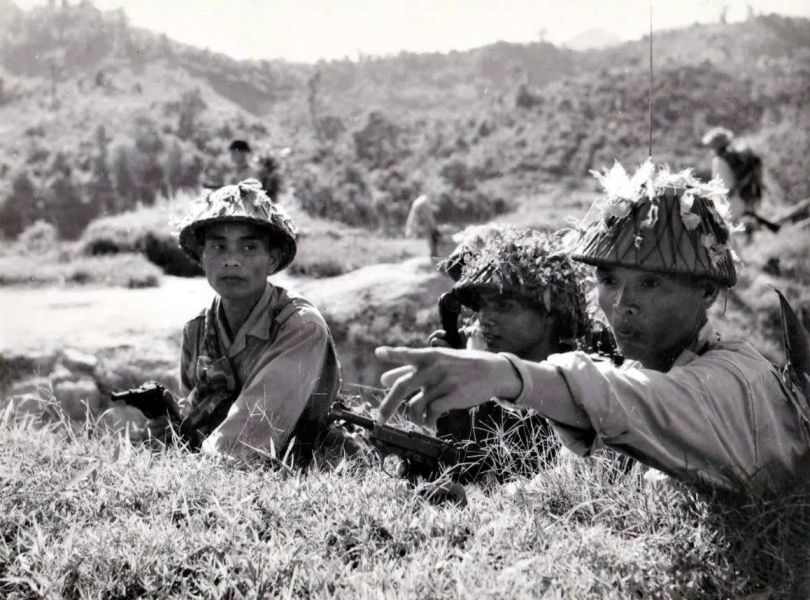 Officers of the PAVN during field maneuvers carrying Walther P38 pistols.
 -