Karabiner 98k: Difference between revisions
Skizmophonic (talk | contribs) Update weapon stats from scripts; hide Fire Rate on semi-auto-only weapons |
Skizmophonic (talk | contribs) Update weapon stats from scripts; remove Fire Rate on semi-auto-only weapons |
||
| Line 32: | Line 32: | ||
! rowspan=2 | [[Weapon Type]] | ! rowspan=2 | [[Weapon Type]] | ||
! rowspan=2 | [[Fire Modes]] | ! rowspan=2 | [[Fire Modes]] | ||
! rolspan=2 | [[Bullet Spread °]] | ! rolspan=2 | [[Bullet Spread °]] | ||
! rolspan=2 | [[Range Modifier]] | ! rolspan=2 | [[Range Modifier]] | ||
| Line 39: | Line 38: | ||
! rolspan=2 | [[Weight]] | ! rolspan=2 | [[Weight]] | ||
|- | |- | ||
|[[Karabiner 98k]]||[[Bolt Action Rifle]]||Semi | |[[Karabiner 98k]]||[[Bolt Action Rifle]]||Semi||5.7 / 0.3 [[ADS]]||0.915||760 m/s||12.8 g (197.53 gr)||3.7 kg (8.16 lbs) | ||
|- | |- | ||
|} | |} | ||
Latest revision as of 00:59, 15 June 2026
| Factions | Weapon | Icon | Classes | Ammo |
|---|---|---|---|---|
 VC |
 Karabiner 98k |
 |
 Assault Assault |
5 / 20 |
| Damage Base | Headshot × | Chest × | Stomach × | Leg × | Arm × | Bayonet | Rifle Grenades | Reload Speed |
|---|---|---|---|---|---|---|---|---|
| 65 | ×2.4 = 156 | ×2.15 = 139.75 | ×1.95 = 126.75 | ×1.15 = 74.75 | ×1.15 = 74.75 | YES | YES | 3.166 Seconds |
| Designation | Weapon Type | Fire Modes | Bullet Spread ° | Range Modifier | Muzzle Velocity | Projectile weight | Weight |
|---|---|---|---|---|---|---|---|
| Karabiner 98k | Bolt Action Rifle | Semi | 5.7 / 0.3 ADS | 0.915 | 760 m/s | 12.8 g (197.53 gr) | 3.7 kg (8.16 lbs) |
| Full name | Caliber | Place of Origin | Date | Manufacturer | Barrel Length | Total Length | Weapon Script Name |
|---|---|---|---|---|---|---|---|
| Karabiner 98k | 7.92x57mm | Nazi Germany | 1934 | Mauser (augmented by several other makers) | 23.62 in (600 mm) | 43.70 in (1,110 mm) | weapon_kar98k |
Karabiner 98k (Kar98k) is a German bolt-action service rifle chambered for the 7.92×57mm Mauser cartridge. It uses the Mauser controlled-feed action and a five-round internal magazine loaded by stripper clips. It is best known as Nazi Germany’s standard infantry rifle of World War II and for its widespread postwar redistribution from captured stocks.
HISTORY
The Kar98k was adopted in the mid-1930s as the standard rifle of the German armed forces, combining the proven Mauser bolt-action system with a compact carbine-length configuration suited to modern infantry service. Mass production during World War II made it one of the most common military rifles of the era, and it became closely associated with German infantry, support troops, and sniper adaptations throughout the conflict.
At the end of World War II, large numbers of Kar98k rifles were captured by Allied forces—especially by the Soviet Union—and many were later redistributed through Cold War military assistance networks. In Southeast Asia, older bolt-action rifles were among the wide mix of small arms that could appear in early and irregular formations, and captured WWII weapons are commonly cited as part of the broader pool of arms supplied to North Vietnam and the Việt Cộng before more modern semi-automatic and assault rifles became dominant.
Sources
- Imperial War Museums Collections (Karabiner 98k entries)
- Royal Armouries Collection (Karabiner 98k entries)
- German Karabiner 98k rifle overview | Pegasus Archive
- Communist Aid to North Vietnam (arms-aid context) | CIA Reading Room
-
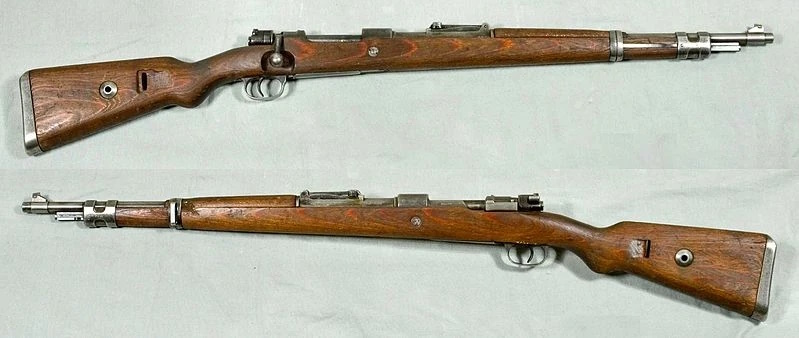 Karabiner 98k bolt-action rifle.
 -
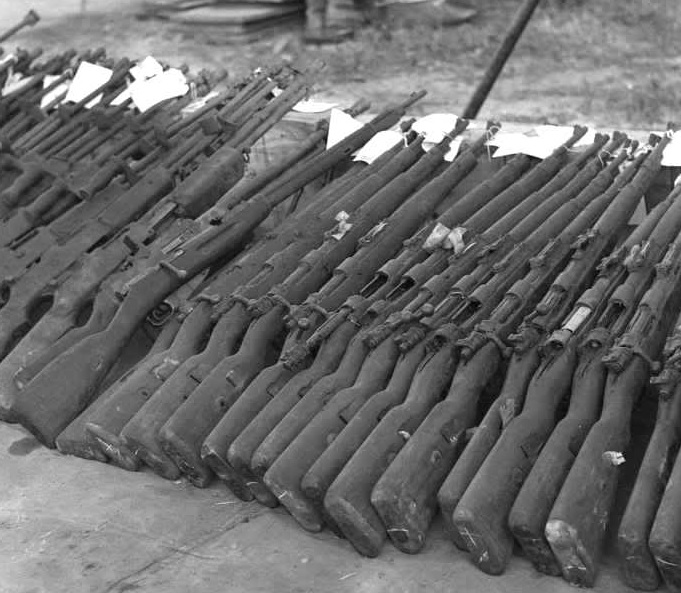 A spread of WWII-era firearms captured from the Việt Cộng by the US Army in the 1960s. No fewer than seventeen 98k rifles are visible, along with a Mosin–Nagant, several Brens, and a PTRD-1941.

