M1 Garand: Difference between revisions
Skizmophonic (talk | contribs) Created page with "{| class="wikitable sortable" style="margin:auto;text-align: center;width:90%" |- ! rowspan=2 style="width:50px" | Factions ! rowspan=2 | Weapon ! rowspan=2 | Icon ! rowspan=2 | Classes ! rowspan=2 | Ammo |- |50px<br><strong>US</strong>|| 512px<br><b> M1 Garand</b> || 512px || 50px <b>Assault</b> || 8 / 24 |- |} {| class="wikitable sortable" style=..." |
Skizmophonic (talk | contribs) Update weapon stats from scripts; remove Fire Rate on semi-auto-only weapons |
||
| (27 intermediate revisions by the same user not shown) | |||
| Line 1: | Line 1: | ||
[[Category:Weapons]] | |||
[[Category:Weapons of Vietnam]] | |||
{| class="wikitable sortable" style="margin:auto;text-align: center;width:90%" | {| class="wikitable sortable" style="margin:auto;text-align: center;width:90%" | ||
|- | |- | ||
| Line 7: | Line 9: | ||
! rowspan=2 | [[Ammo]] | ! rowspan=2 | [[Ammo]] | ||
|- | |- | ||
|[[File:Flag_us_new.png|50px]]<br><strong>[[US]]</strong>|| [[File:M1g.png|512px]]<br><b> [[M1 Garand]]</b> || [[File:Weapon m1g.svg|512px]] || [[File:Class_Assault.png|50px]] <b>[[Assault]]</b> || 8 / | |[[File:Flag_us_new.png|50px]]<br><strong>[[US]]</strong>||[[File:M1g.png|512px]]<br><b> [[M1 Garand]]</b>||[[File:Weapon m1g.svg|512px]]||[[File:Class_Assault.png|50px]] <b>[[Assault]]</b>||8 / 48 | ||
|- | |- | ||
|} | |} | ||
| Line 20: | Line 22: | ||
! rowspan=2 | [[Bayonet]] | ! rowspan=2 | [[Bayonet]] | ||
! rowspan=2 | [[Rifle Grenades]] | ! rowspan=2 | [[Rifle Grenades]] | ||
! rowspan=2 | Reload Speed | |||
|- | |- | ||
| || | |55||×2.45 = 134.75||×1.2 = 66||×1.15 = 63.25||×0.8 = 44||×0.7 = 38.5||YES||YES||3.33 Seconds | ||
|- | |- | ||
|} | |} | ||
| Line 29: | Line 32: | ||
! rowspan=2 | [[Weapon Type]] | ! rowspan=2 | [[Weapon Type]] | ||
! rowspan=2 | [[Fire Modes]] | ! rowspan=2 | [[Fire Modes]] | ||
! rolspan=2 | [[Bullet Spread °]] | ! rolspan=2 | [[Bullet Spread °]] | ||
! rolspan=2 | [[Range Modifier]] | ! rolspan=2 | [[Range Modifier]] | ||
| Line 36: | Line 38: | ||
! rolspan=2 | [[Weight]] | ! rolspan=2 | [[Weight]] | ||
|- | |- | ||
|[[]]||[[]]|| | |[[M1 Garand]]||[[Battle Rifle]]||Semi||6.15 / 1.05 [[ADS]]||0.965||853 m/s||10 g (154.32 gr)||4.31 kg (9.5 lbs) | ||
|- | |- | ||
|} | |} | ||
| Line 42: | Line 44: | ||
|- | |- | ||
! rowspan=2 | Full name | ! rowspan=2 | Full name | ||
! rowspan=2 | [[ | ! rowspan=2 | [[Caliber]] | ||
! rowspan=2 | [[Place of Origin]] | ! rowspan=2 | [[Place of Origin]] | ||
! rowspan=2 | [[Date]] | ! rowspan=2 | [[Date]] | ||
! rowspan=2 | [[ | ! rowspan=2 | [[Manufacturer]] | ||
! rowspan=2 | Barrel Length | ! rowspan=2 | Barrel Length | ||
! rowspan=2 | Total Length | ! rowspan=2 | Total Length | ||
! rowspan=2 | [[Weapon Script Name]] | ! rowspan=2 | [[Weapon Script Name]] | ||
|- | |- | ||
| | |U.S. Rifle, Caliber .30, M1||7.62x63mm||[[USA]]||1937||Springfield Armory||24 in (609.6 mm)||43.5 in (1,100 mm)||weapon_m1g | ||
|- | |- | ||
|} | |} | ||
<hr> | <hr> | ||
'''M1 Garand''' (U.S. Rifle, Caliber .30, M1) is an American semi-automatic service rifle chambered for the .30-06 Springfield cartridge. It is loaded using an eight-round en-bloc clip and uses a gas-operated, rotating-bolt action. It is best known as the standard U.S. infantry rifle of World War II and the Korean War, prized for its rapid, accurate fire compared to contemporary bolt-action rifles. | |||
==HISTORY== | |||
Designed by John C. Garand at Springfield Armory, the M1 was adopted by the U.S. Army in 1936 as the first semi-automatic rifle to be issued as America’s standard service rifle. The rifle’s gas-operated mechanism and eight-round clip system provided a major increase in practical rate of fire while retaining full-power rifle performance, and the M1 became one of the defining American small arms of World War II and later the Korean War. | |||
Although replaced as the primary U.S. service rifle in the postwar period, the M1 remained in inventories for years afterward and continued to appear in later roles, including sniper use with variants such as the M1C and [[M1D]]. In the early Vietnam War era, U.S. allies in South Vietnam were still equipped in part with surplus M1 rifles and other World War II–era small arms, and the M1 could be encountered alongside newer 7.62mm and 5.56mm weapons as the conflict and allied re-equipment progressed. | |||
===Sources=== | |||
* [https://americanhistory.si.edu/collections/object/nmah_418516 United States M1 Rifle | Smithsonian National Museum of American History] | |||
* [https://www.nps.gov/spar/learn/historyculture/john-c-garand.htm John Garand | Springfield Armory National Historic Site (U.S. National Park Service)] | |||
* [https://www.nps.gov/articles/springfieldarmoryww2.htm Springfield Armory: The Best Battle Implement Ever Devised | U.S. National Park Service] | |||
* [https://history.army.mil/portals/143/Images/Publications/catalog/40-6-1.pdf A History of Innovation: U.S. Army Adaptation in War and Peace (includes M1 Garand section) | U.S. Army Center of Military History] | |||
* [https://www.armyupress.army.mil/Journals/Military-Review/English-Edition-Archives/March-April-2022/Durham/ Speed versus Quality | Army University Press] | |||
<hr> | <hr> | ||
<gallery mode="packed" heights="400px"> | <div class="mw-collapsible" style="border:1px solid #ccc; padding:5px; width:100%;"> | ||
File: | <div style="text-align:center; font-weight:bold;">Real-Life Photos</div> | ||
</gallery> | <div class="mw-collapsible-content" style="margin-top:0.5em;"> | ||
<gallery mode="packed" heights="400px"> | |||
File:M1 Garand rifle USA noBG new.png|M1 Garand rifle. | |||
File:Anatomy-m1garand.png|[https://www.candrsenal.com/product/anatomy-us-rifle-m1-garand/ Buy a print of this here] | |||
File:1961arvnrangers.jpg | |||
File:July1961.jpg | |||
</gallery> | |||
</div> | |||
</div> | |||
<hr> | |||
{{# | <div class="mw-collapsible" style="border:1px solid #ccc; padding:5px; width:100%;"> | ||
<div style="text-align:center; font-weight:bold;">Videos</div> | |||
| | <div class="mw-collapsible-content" style="margin-top:0.5em;"> | ||
| | {{#ev:youtube|iNK1KteoWf8}} | ||
}} | {{#ev:youtube|ckyhnGtve0c}} | ||
{{#ev:youtube|6HEAA0C6a4Q}} | |||
{{#ev:youtube|s5V_qIZEOUg}} | |||
{{#ev:youtube|5Rg6pbPtrIU}} | |||
</div> | |||
</div> | |||
Latest revision as of 00:59, 15 June 2026
| Factions | Weapon | Icon | Classes | Ammo |
|---|---|---|---|---|
 US |
 M1 Garand |
 |
 Assault Assault |
8 / 48 |
| Damage Base | Headshot × | Chest × | Stomach × | Leg × | Arm × | Bayonet | Rifle Grenades | Reload Speed |
|---|---|---|---|---|---|---|---|---|
| 55 | ×2.45 = 134.75 | ×1.2 = 66 | ×1.15 = 63.25 | ×0.8 = 44 | ×0.7 = 38.5 | YES | YES | 3.33 Seconds |
| Designation | Weapon Type | Fire Modes | Bullet Spread ° | Range Modifier | Muzzle Velocity | Projectile weight | Weight |
|---|---|---|---|---|---|---|---|
| M1 Garand | Battle Rifle | Semi | 6.15 / 1.05 ADS | 0.965 | 853 m/s | 10 g (154.32 gr) | 4.31 kg (9.5 lbs) |
| Full name | Caliber | Place of Origin | Date | Manufacturer | Barrel Length | Total Length | Weapon Script Name |
|---|---|---|---|---|---|---|---|
| U.S. Rifle, Caliber .30, M1 | 7.62x63mm | USA | 1937 | Springfield Armory | 24 in (609.6 mm) | 43.5 in (1,100 mm) | weapon_m1g |
M1 Garand (U.S. Rifle, Caliber .30, M1) is an American semi-automatic service rifle chambered for the .30-06 Springfield cartridge. It is loaded using an eight-round en-bloc clip and uses a gas-operated, rotating-bolt action. It is best known as the standard U.S. infantry rifle of World War II and the Korean War, prized for its rapid, accurate fire compared to contemporary bolt-action rifles.
HISTORY
Designed by John C. Garand at Springfield Armory, the M1 was adopted by the U.S. Army in 1936 as the first semi-automatic rifle to be issued as America’s standard service rifle. The rifle’s gas-operated mechanism and eight-round clip system provided a major increase in practical rate of fire while retaining full-power rifle performance, and the M1 became one of the defining American small arms of World War II and later the Korean War.
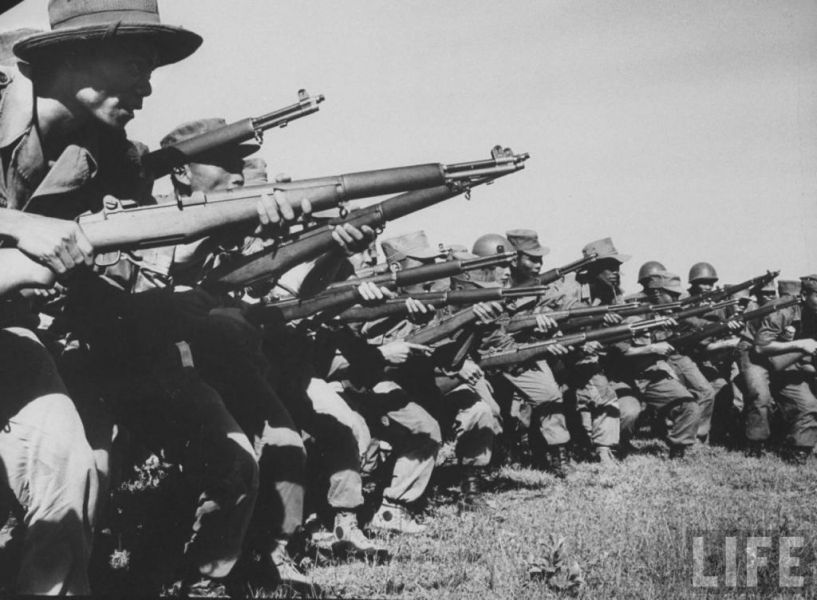
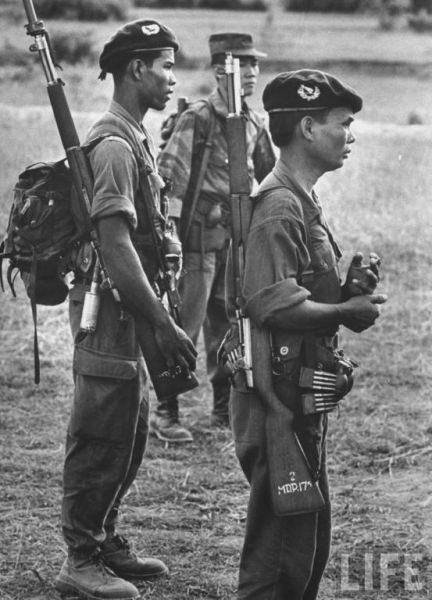
Although replaced as the primary U.S. service rifle in the postwar period, the M1 remained in inventories for years afterward and continued to appear in later roles, including sniper use with variants such as the M1C and M1D. In the early Vietnam War era, U.S. allies in South Vietnam were still equipped in part with surplus M1 rifles and other World War II–era small arms, and the M1 could be encountered alongside newer 7.62mm and 5.56mm weapons as the conflict and allied re-equipment progressed.
Sources
- United States M1 Rifle | Smithsonian National Museum of American History
- John Garand | Springfield Armory National Historic Site (U.S. National Park Service)
- Springfield Armory: The Best Battle Implement Ever Devised | U.S. National Park Service
- A History of Innovation: U.S. Army Adaptation in War and Peace (includes M1 Garand section) | U.S. Army Center of Military History
- Speed versus Quality | Army University Press
-
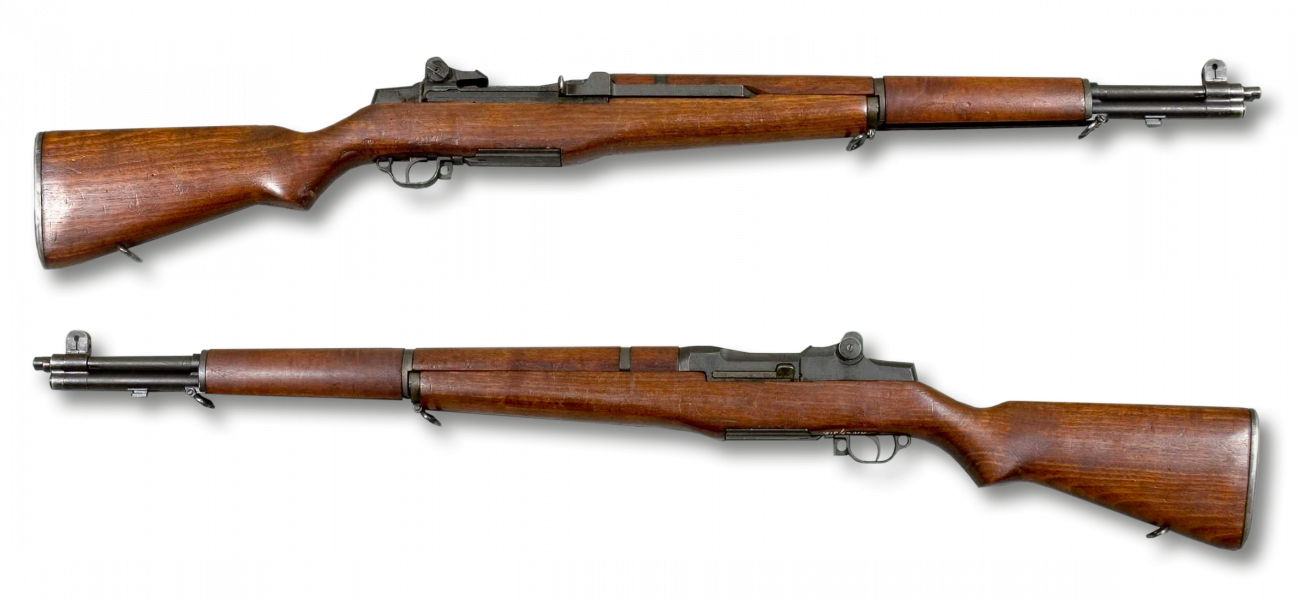 M1 Garand rifle.
 -
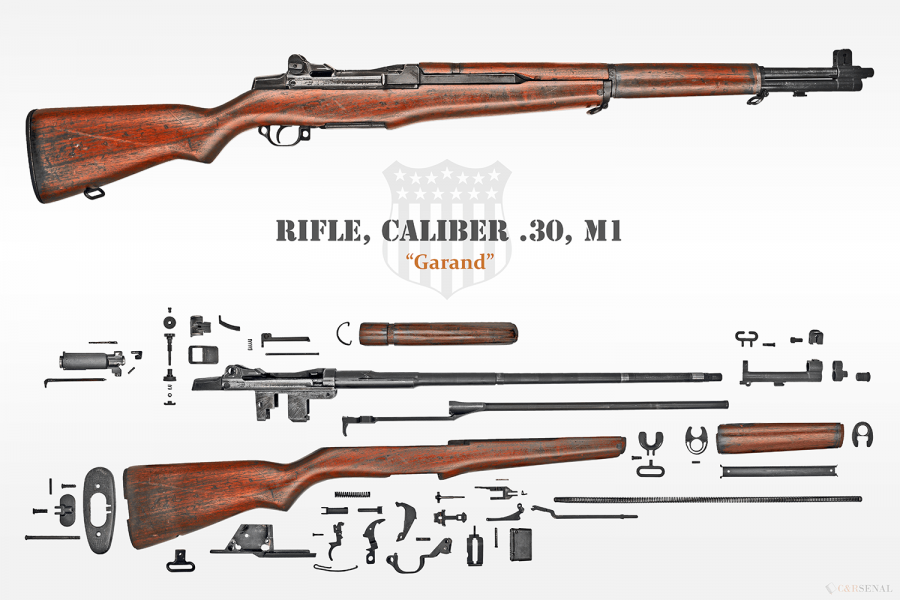
-
-