M69 Flak Vest: Difference between revisions
Skizmophonic (talk | contribs) Skizmophonic moved page M69 Flak Vest to Body Armor Tag: New redirect |
Skizmophonic (talk | contribs) No edit summary |
||
| (2 intermediate revisions by the same user not shown) | |||
| Line 1: | Line 1: | ||
[[Category:Equipment of Vietnam]] | |||
{| class="wikitable sortable" style="margin:auto;text-align: center;width:90%" | |||
|- | |||
! rowspan=2 style="width:50px" | [[Factions]] | |||
! rowspan=2 | Equipment | |||
! rowspan=2 | Icon | |||
! rowspan=2 | [[Classes]] | |||
! rowspan=2 | Equip Weight | |||
|- | |||
|- | |||
|[[File:Flag_us_new.png|50px]]<br><strong>[[US]]</strong>|| [[File:us_body_armor.png|250px]]<br><b>[[M69 Flak Vest]]</b> || [[File:Weapon_bodyarmor.svg|170px]] || <b>All</b><br> || 4 | |||
|- | |||
|} | |||
<hr> | |||
'''The M69 Flak Vest''' is the U.S. body armor item in ''Military Conflict: Vietnam''. It is based on the U.S. Army fragmentation vest used during the Vietnam War, recognizable by its raised 3/4 collar. | |||
==In-Game Function== | |||
When equipped, the M69 Flak Vest uses the standard [[Body Armor]] damage reduction. Explosive damage is reduced by 30% across all body regions. Shotguns and the [[QSPR]] are reduced by 20% on torso hits. All other weapons are reduced by 10% on torso hits. | |||
==HISTORY== | |||
The M69 was not meant to make a soldier bulletproof. Like other flak vests of its era, it was built mainly to reduce wounds from fragments thrown by shells, grenades, mines, and bombs. It followed earlier U.S. Army body armor such as the M-1952 fragmentation vest, with the most visible change being the raised 3/4 collar around the neck. | |||
The vest was made with layers of ballistic nylon sealed inside a waterproof casing and covered by an olive-drab outer shell. Examples show the familiar front zipper, pockets, side lacing, and collar that gave the M69 its distinctive shape. U.S. Army historical writing lists the vest at about 8.4 lb and describes it as broadly similar to the M-1952, with the collar as its main improvement. | |||
In Vietnam, that protection came with a cost. The vest was bulky, trapped heat and moisture, and could be uncomfortable in the tropical climate. Because of that, it was not always worn on patrol, but it could be more practical for troops in static defensive positions, unarmored vehicle convoys, and some aviation roles. | |||
===Sources=== | |||
* [https://www.awm.gov.au/collection/C988504 M69 Fragmentation protective body armour vest | Australian War Memorial] | |||
* [https://www.iwm.org.uk/collections/item/object/30014209 Body Armour, M69 Fragmentation Vest: US | Imperial War Museums] | |||
* [https://arsof-history.org/articles/19oct_body_armor_page_1.html "This Vest May Save Your Life!": U.S. Army Body Armor from World War II to Present | U.S. Army Special Operations History Office] | |||
* [https://www.awm.gov.au/collection/REL34208 M-1969 Pattern Fragmentation Protective Body Armor Vest: Neil Davis | Australian War Memorial] | |||
<hr> | |||
<div class="mw-collapsible" style="border:1px solid #ccc; padding:5px; width:100%;"> | |||
<div style="text-align:center; font-weight:bold;">Real-Life Photos</div> | |||
<div class="mw-collapsible-content" style="margin-top:0.5em;"> | |||
<gallery mode="packed" heights="400px"> | |||
File:M69 2 whiteBG.jpg|amerikanische "Flack Jacket" M69 aus dem Vietnamkrieg (US-Army) | |||
File:2nd Battalion, 506th Infantry soldier reads mail at Firebase Ripcord.jpg|A member of the 2nd Battalion, 506th Infantry, 101st Airborne Division, reads his mail during a break between fire missions at Fire Support Base Ripcord. NARA 111-CCV-284-CC70195 | |||
File:Flak Jacket.jpg|U.S. Army soldier wearing flak jacket, Vietnam, 1971 | |||
File:William Turner and Interpreter Examine an AK-47 Assault Rifle, 1968 (28717475393).jpg|War Prize: Staff Sergeant William T. Turner, 33 (Shreveport, Louisiana) and a Vietnamese interpreter examine a captured AK-47 assault rifle found by E Company, 2d Battalion, 5th Marines (official USMC photo by Private A. | |||
File:1967, 27 February,Company C, 9th Marines, Operation Chinhook.jpg|27 February 1967: Knee Deep: Marines of Company C, 9th Marines, move through swampland searching for Viet Cong near the ‘street without joy’ during Operation Chinook. | |||
</gallery> | |||
</div> | |||
</div> | |||
<hr> | |||
<div class="mw-collapsible" style="border:1px solid #ccc; padding:5px; width:100%;"> | |||
<div style="text-align:center; font-weight:bold;">Videos</div> | |||
<div class="mw-collapsible-content" style="margin-top:0.5em;"> | |||
<!-- No recommended video yet. Prefer a museum or archival equipment overview before adding one. --> | |||
</div> | |||
</div> | |||
Latest revision as of 04:27, 9 June 2026
| Factions | Equipment | Icon | Classes | Equip Weight |
|---|---|---|---|---|
 US |
 M69 Flak Vest |
 |
All |
4 |
The M69 Flak Vest is the U.S. body armor item in Military Conflict: Vietnam. It is based on the U.S. Army fragmentation vest used during the Vietnam War, recognizable by its raised 3/4 collar.
In-Game Function
When equipped, the M69 Flak Vest uses the standard Body Armor damage reduction. Explosive damage is reduced by 30% across all body regions. Shotguns and the QSPR are reduced by 20% on torso hits. All other weapons are reduced by 10% on torso hits.
HISTORY
The M69 was not meant to make a soldier bulletproof. Like other flak vests of its era, it was built mainly to reduce wounds from fragments thrown by shells, grenades, mines, and bombs. It followed earlier U.S. Army body armor such as the M-1952 fragmentation vest, with the most visible change being the raised 3/4 collar around the neck.
The vest was made with layers of ballistic nylon sealed inside a waterproof casing and covered by an olive-drab outer shell. Examples show the familiar front zipper, pockets, side lacing, and collar that gave the M69 its distinctive shape. U.S. Army historical writing lists the vest at about 8.4 lb and describes it as broadly similar to the M-1952, with the collar as its main improvement.
In Vietnam, that protection came with a cost. The vest was bulky, trapped heat and moisture, and could be uncomfortable in the tropical climate. Because of that, it was not always worn on patrol, but it could be more practical for troops in static defensive positions, unarmored vehicle convoys, and some aviation roles.
Sources
- M69 Fragmentation protective body armour vest | Australian War Memorial
- Body Armour, M69 Fragmentation Vest: US | Imperial War Museums
- "This Vest May Save Your Life!": U.S. Army Body Armor from World War II to Present | U.S. Army Special Operations History Office
- M-1969 Pattern Fragmentation Protective Body Armor Vest: Neil Davis | Australian War Memorial
-
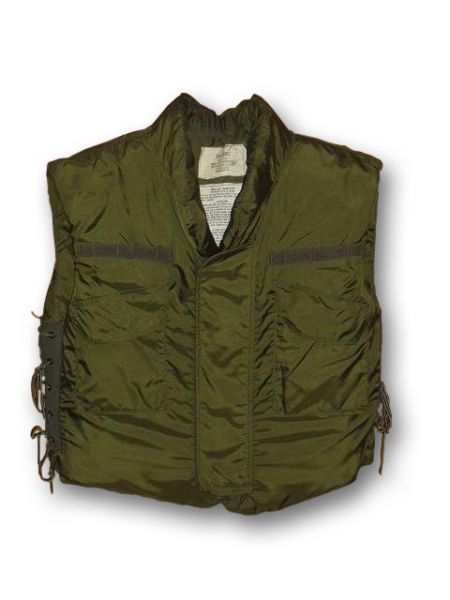 amerikanische "Flack Jacket" M69 aus dem Vietnamkrieg (US-Army)
 -
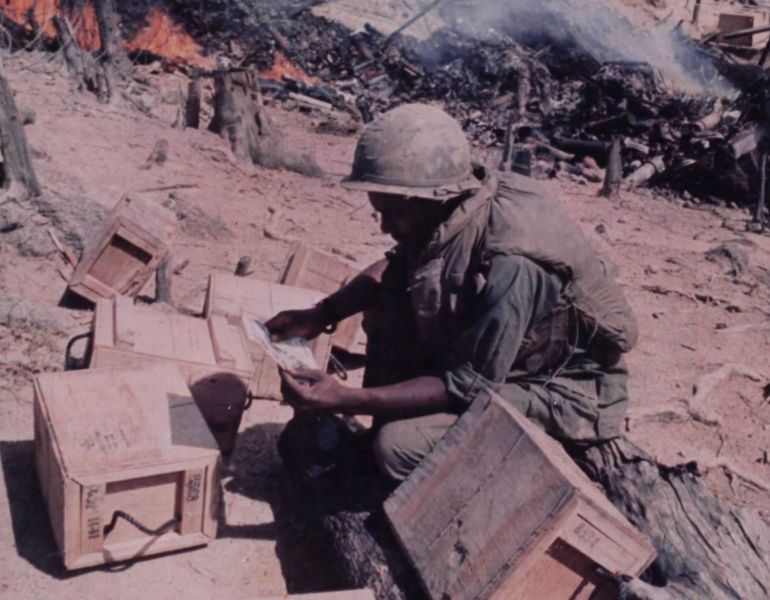 A member of the 2nd Battalion, 506th Infantry, 101st Airborne Division, reads his mail during a break between fire missions at Fire Support Base Ripcord. NARA 111-CCV-284-CC70195
 -
 U.S. Army soldier wearing flak jacket, Vietnam, 1971
 -
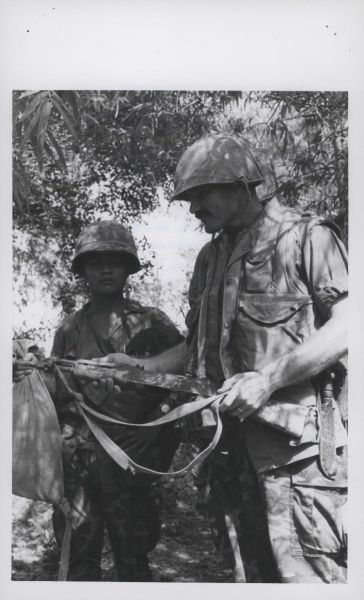 War Prize: Staff Sergeant William T. Turner, 33 (Shreveport, Louisiana) and a Vietnamese interpreter examine a captured AK-47 assault rifle found by E Company, 2d Battalion, 5th Marines (official USMC photo by Private A.
 -
 27 February 1967: Knee Deep: Marines of Company C, 9th Marines, move through swampland searching for Viet Cong near the ‘street without joy’ during Operation Chinook.


.jpg)
